
Free Article


Addressing Social Competencies and Social Anxiety
Using the Spirals of Anxiety
Michelle Garcia Winner, MA, CCC-SLP
Summary:
- Anxiety can make it harder for students to access social skills and strategies they already know.
- The Spirals of Anxiety framework explores how thoughts, feelings, and actions can either support or hinder social success.
- Building social competencies alongside anxiety-management strategies can help students approach challenging social situations with greater confidence.
Years ago, an astute clinician strongly encouraged our team to explore how social learning and anxiety intersect as part of the Social Thinking® Methodology. While we realized we had been teaching social strategies that seemed to reduce anxiety, we were not really teaching about how anxiety impacts social learning. This is mainly because we are a group of speech-language pathologists, and that seemed to be crossing into the domain of mental health. But as we learned about how anxiety can impact the well-being of students who have stronger social and self-awareness (both neurotypical and neurodivergent), it was clear that social anxiety was undermining their ability to access their social competencies when stressed. For those familiar with our work, we encourage an interdisciplinary viewpoint, which means we all should be learning about social pragmatics, sensory systems, emotional regulation, counseling, behaviorism, educational demands, etc. This doesn’t mean people should become practicing professionals in those areas but rather become informed team members. We believe those who are in the role of supporting students must be aware of the whole person and their overall needs and goals. With this philosophy in mind, we began to explore the role of anxiety in social learning.
Anxiety Aha! Insights
The more I explored traditional treatments for anxieties, the more I realized that different types of anxiety require different types of support. For example, there are “phobic anxieties” where students will not engage in a particular behavior due to fears about a specific event (e.g., won’t flush a toilet; won’t go in an elevator, etc.). This type of anxiety is often managed well with a cognitive-behavioral therapy focusing on recognizing when a fear is healthy or reasonable and when it is not healthy or unreasonable (e.g., flushing a toilet). Another type of anxiety is social anxiety. Social anxiety, as the words suggests, is anxiety with a social twist. But it’s not just about a fear of talking with someone. Social anxiety can be much more complex and includes meeting new people, asking for help or directions, initiating a call, being in a job interview, presenting to a group, going on a date, expressing an opinion, volunteering, and a host of others. This means that supporting those with social anxieties is not as simple as addressing the fear and then simply desensitizing. Social anxiety is the complex interplay that involves the person, the social situation, how they process what is happening, and then being able to decide what to do (or not do) in that moment. It is complicated!
Social situations are dynamic and complex involving processing and responding to several cues all at once (e.g., nonverbal, verbal, situational and perspective-taking). In a nutshell, supporting a person who has social anxiety will need to focus on helping them learn a range of social competencies and strategies to use when in increasingly complex and/or stressful social contexts. So, we teach individuals that building or recognizing their social competencies can help to mitigate some of their social anxieties.
Several years ago, I developed a tool, alongside and with input from my clients, to help them deal with the complexity of learning about their own social anxiety while also learning about their own social competencies. We collectively named it, The Spirals (i.e., Spiral of Social Success* and Spiral of Social Failure*).
*Note: Success and Failure are terms that were used and resonated most with my clients as they tried to describe their experiences with social anxiety and accessing their social competencies. This tool is not about teaching success or failure but rather a way to explain how anxiety can result in not being able to access your social strategies or strengths (failure) and how managing anxiety can result in being able to access your social strategies or strengths (success).
The Spirals are informed by metacognitive teachings and highlight the spiral of thoughts, feelings, and actions people may experience in response to a social expectation that leads to either social success or social failure. It also illustrates the importance of learning to manage our social anxiety in partnership with developing or encouraging the use of our social competencies.
Strategies Must Belong to the Individual—Not Us
If we impose or teach strategies without the input and buy-in as to the relevance of that strategy in an individual’s life, then we have wasted our time and theirs. The strategies we introduce must be flexible enough for the individual to feel like the tool can fit and support their unique circumstances. In other words, if we are the person taking ownership of their stated problem or goal, then there is no ownership on the part of the individual to use the strategy in the future. That said, we need to be transparent in teaching that some strategies may not make their lives feel more comfortable or easy at first. Just like learning any new way of thinking or doing, it can feel uncomfortable and even a little stressful. We need to assure them it's okay to feel some stress —we all do at times. Lastly, we need to help them to feel proud of themselves for their progress.
Important Note: This tool is for those who report or show anxiety related to social situations or social anxiety (e.g., hanging out with peers, calling, joining groups, etc.) and not for more literal learners who may express or show anxiety around “world-based” anxieties (e.g., flushing toilets, loud sounds, fans, schedules, etc.).
The Self-Defeater’s Role in the Spirals
Most of us rely on an inner coach or private voice in our heads to encourage us to do or try things that are uncomfortable or remind us that we already know how to do something (i.e., competencies to get through the social demand or task we are stressing over).
The opposite is having a self-defeater or inner critic voice in our heads. This voice, rather than encouraging us to push through something or recognize we have the competencies says, “You’re no good at this,” or “You have never been able to do this, so you won’t be able to do it now.” Those who have a powerful self-defeater voice often default to avoiding the uncomfortable task at hand, while those with a strong inner coach have a far better chance of pushing themselves through the uncomfortable task.
Strong self-defeater voices can flood us with benign excuses for avoiding the task at hand and not pushing through an uncomfortable moment. Instead, the self-defeater voice defaults to reasons why we shouldn’t try. During our clinical sessions, we take the time to explore these self-defeating comments and reasons for avoiding or not trying something. Here are some examples for not making phone calls (or even texting) established friends. (Note: These comments came from students who had worked to develop the social competencies needed for calling/texting but were still struggling with social anxiety.)
- I was busy and they don’t want to hear from me anyway.
- I had too much homework to call.
- I will do it tomorrow, but I’m not good at it.
- I will do it next year when I am in a new school.
- I could not find my cell phone and I never remember their number.
Group Plan: Re-Train the Brain
Our group started discussing how our brains are always learning. If we default to doing or saying that same old things (e.g., what we are used to), then we are teaching our brains we can only do what is familiar or routine. So, if students are used to thinking and feeling like they can’t use their cell to call, then they have taught their brains that they literally do not have the ability to do it. Our group also took the time to explore and study default patterns; what our brains are most comfortable doing and what we teach our brains when listening to the self-defeater voice.
So, helping students to explore options for trying new or stressful or anxiety provoking actions needed to start with building the social competencies first. These strategies were developed alongside the student and each student was encouraged to show or prove to themselves that they already built the competencies in a safe environment (clinic or school group). Do this first before ever being asking them to try anxiety-laden tasks outside of this setting. We also learned that anxiety has deep roots and does not want to go away easily! This means that even when students show themselves that they have increased competencies, their anxiety may still get in the way of accessing their strategies.
The following is a short overview of how to introduce the Spirals. Please always start by teaching the Spiral of Social Success first. Note that the movement in the spiral relies on accessing one’s inner coach, strategies, and emotion awareness. If the student struggles with any of these core components, then please make sure to go back and teach before moving through the rest of the spiral teaching.
The Spiral of Social Success
The Spiral of Social Success encourages a growth mindset because it teaches that we can better manage our social anxieties by developing a positive mindset and learning specific strategies that foster development of social competencies. This spiral also encourages metacognitive awareness to help social learners coach themselves through socially stressful times.
Concepts to Focus On When Teaching
- Students have a choice in how to respond when social anxiety strikes.
- Focus one’s attention on navigating through the social interaction, rather than focusing on one’s social anxiety.
- Practice strategies for developing needed social competencies, as well as managing one’s anxiety.
- A can-do perspective is powerful! Guide students toward feeling positive, rather than negative, about their ability to socially engage with others.
- Social interactions can be uncomfortable. Learn to become comfortable with discomfort in pursuit of one’s social goals.
- Be patient with yourself. Learn to manage your anxiety while affirming your social competencies.
A social situation happens...
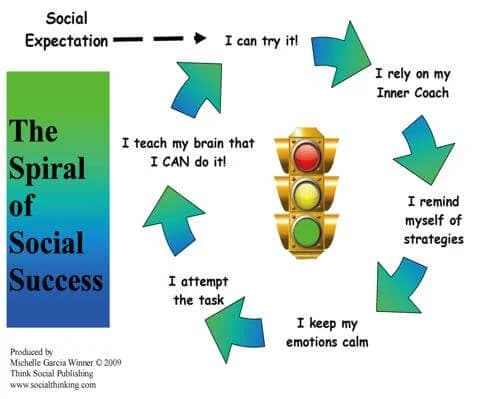
- You may encounter some stress approaching this situation. In the past, your self-defeater voice pushed you to bail out due to anxiety. Instead of starting by doubting yourself, explore what strategies you can use to deal with the uncomfortable social situation.
- Use your inner coach to remind yourself how much better you will feel once you use your strategies. Remind yourself that you know these strategies. Tell yourself, “I can try this.”
- Remind yourself that you already know and have practiced strategies. Give yourself a break and recognize that you feel better when you see yourself demonstrating your social competencies.
- This encourages you to implement the use of the strategies.
- This results in the fact you are training your brain that “you can do it” better than you have done it before!
The Spiral of Social Failure
The Spiral of Social Failure explains how and why individuals struggle to learn to manage their social anxiety. This spiral helps individuals notice a pattern that likely exists within them when trapped in a negative mindset. This also encourages interventionist to discuss with social learners what they experience at each point of the spiral.
Concepts to Focus On When Teaching
- When individuals create a negative mindset, it leads them to doubt they can do anything differently, perpetuating their negative mindset.
- The difference in one’s actions when using one’s internal self-defeater versus inner coach voice.
- People often make excuses to avoid learning and/or practicing new strategies, although they may not realize it.
- This negative thinking process leads people further into negative feelings about their ability to relate to others, further limiting the chance they will seek to relate.
- People experience learning avoidance which teaches their brains, over and over again, that they “can’t do it!”
A social situation happens...
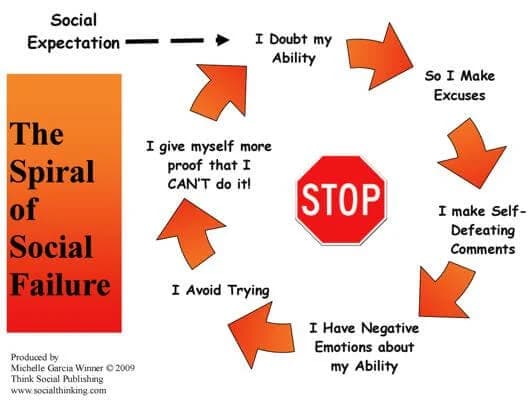
Here's how this looks:
- You encounter the same stressful situation.
- Your self-defeater voice fills your brain with reasons and excuses for why you won't engage in this situation today.
- Your self-defeater voice tells you, “you can't do it” and that “you have never been able to do it”.
- You feel negative emotions and listen to your self-defeater voice.
- You want to avoid putting yourself in the situation.
- You teach your brain (or your brain learns) that you cannot do it! Your memory of this situation reinforces that you just can’t do it!
From our experience, teaching with the Spirals can:
- Help individuals take responsibility for their own learning and accomplishments.
- Change the conversation from offering reasons or self-defeating excuses for not trying to talking about successes and effort in trying.
- Teach that the spirals can teach their brains in a proactive way or self-defeating way.
- Motivate individuals to recognize their own strengths and social competencies.
Can Individuals Have Both Social Competencies and Social Anxiety?
Based on our clinical experience, some students have developed social competencies but still have high levels of anxiety. While the Spirals lessons may be helpful to some, it is best practice to have a mental health professional figure out the complexities of anxiety.
Other Resources Related to Anxiety and Social Competencies
- Hey Warrior: A Book for Kids About Anxiety
- Starving the Anxiety Gremlin
- Socially Curious and Curiously Social
Thanks for reading! Join our newsletter and be the first to hear about our latest products, articles, and more!